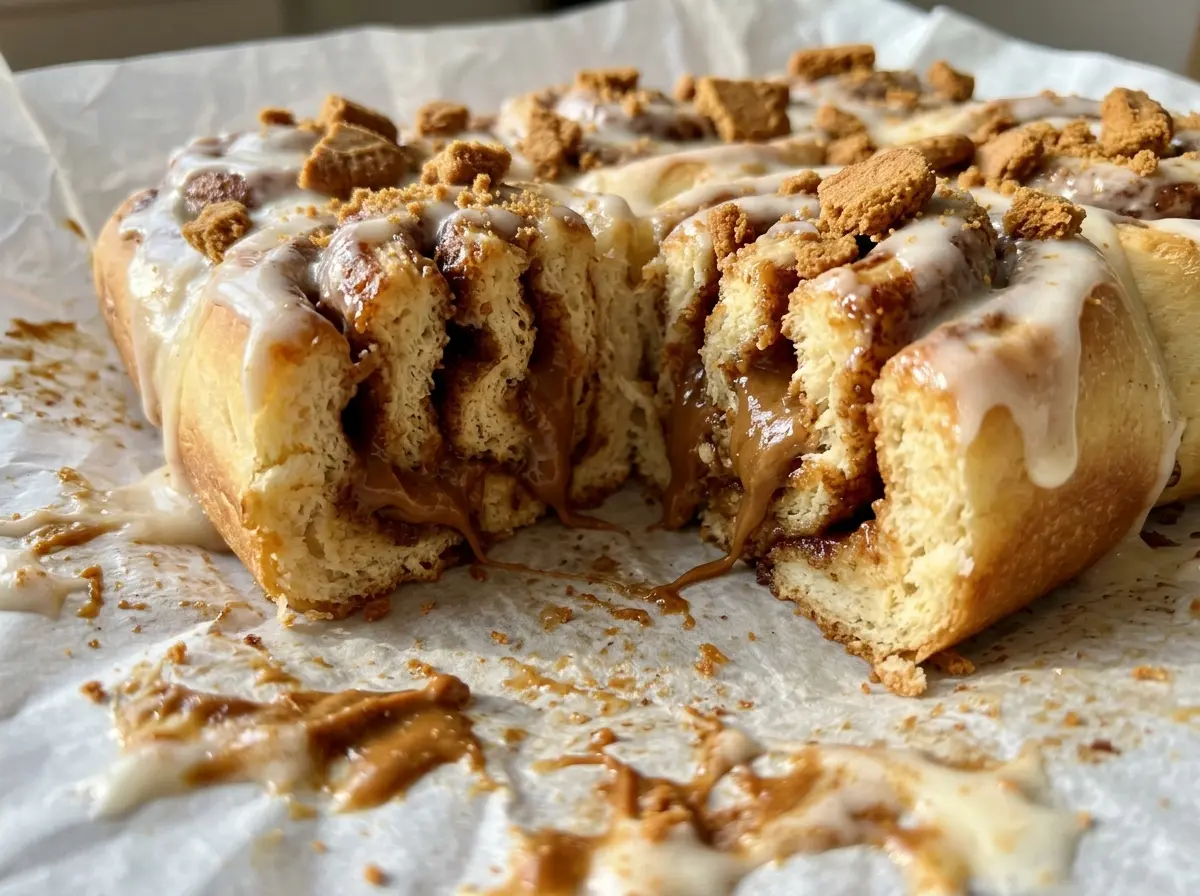
The first thing you notice is how soft the dough feels after kneading: smooth, a little tacky, and ready to wrap around a generous cinnamon-cookie-butter filling. I make these Biscoff cinnamon rolls when I want the familiar pull-apart softness of a cinnamon roll with a deeper, spiced cookie flavor running through every spiral.
The filling comes together with softened butter, brown sugar, cinnamon, and cookie butter. That softened butter matters: it helps the mixture spread into an even layer instead of turning into a loose puddle that’s hard to keep inside the dough. Once the rolls are baked, a cream cheese and Biscoff icing melts into the warm spirals without hiding the cinnamon underneath.
Give the dough time to rise until it has doubled, then let the shaped rolls get puffy before they go into the oven. Those pauses are what give you tender centers and distinct, cinnamon-swirled layers, finished with a creamy coat of Biscoff icing.
Kitchen Note
Use a thermometer for the milk rather than guessing by touch: it should be 105–110°F. The melted butter should be cooled before it goes in with the egg, so the mixture stays comfortably warm for the yeast.
Save these Biscoff cinnamon rolls for a cozy bake: tender spirals, cinnamon-cookie-butter filling, and a cream cheese Biscoff icing.
Why Softened Butter Keeps the Biscoff Filling Spreadable
Cookie butter is already smooth, but it’s thick enough to drag at soft dough if you spread it on its own. Mixing it with softened butter, brown sugar, and cinnamon makes a cohesive filling that moves across the dough without pulling or tearing it. The mixture should look like a soft, even paste, not a shiny liquid.
Melted butter changes that consistency. It loosens the filling, making it more likely to run toward the edges as you spread it and roll the dough. Softened butter blends in while holding enough body to stay in an even layer, so each slice gets a defined spiral. If your kitchen is cool and the butter is still firm, give it more time to soften rather than melting it to speed things along.
That even layer also helps the brown sugar and cinnamon stay distributed through the rolls instead of collecting in a few dense patches. Spread the filling all the way across the rectangle, keeping the layer consistent from edge to edge. A steady, gentle hand is better than pressing hard enough to stretch the dough out of shape.
What Gives These Rolls Their Soft Dough and Spiced Center

- Instant yeast — It can be whisked directly into the warm milk mixture, which keeps the dough method straightforward. Keep the yeast fresh and stored according to its package; active dry yeast can also work, but let it dissolve and foam in the warm milk mixture before stirring in the flour.
- Whole milk, egg, and egg yolk — These give the dough richness and tenderness. Whole milk makes a softer dough than water, while the extra yolk adds richness. Two-percent milk works if that’s what you have, though the dough may be a little less tender.
- All-purpose flour — It makes a dough that’s sturdy enough to roll while staying soft after baking. Add only enough flour to keep the work surface lightly dusted; packing extra into the dough can make the finished rolls firm.
- Biscoff cookie butter — Its spiced-cookie taste is the defining flavor here, and a smooth speculoos-style cookie butter is the closest swap if you can’t find Biscoff. A crunchy spread won’t give you the same smooth, even filling.
- Light brown sugar and cinnamon — Brown sugar gives the filling a molasses note that works especially well with the cookie butter, while cinnamon keeps it recognizable as a cinnamon roll. Dark brown sugar can stand in for light brown sugar when you want a deeper, more molasses-forward filling.
- Cream cheese — It keeps the icing tangy enough to balance the sweet cookie butter and powdered sugar. Use it softened so it beats smoothly; cold cream cheese tends to leave small lumps in the finished icing.
From Enriched Dough to Soft, Swirled Rolls
Mix and Knead Until the Dough Turns Elastic
Whisk the warm milk, instant yeast, granulated sugar, egg, egg yolk, and cooled melted butter in a large bowl. Stir in the flour and salt until you have a shaggy dough, then knead it on a lightly floured surface for 8–10 minutes. It’s ready when it feels smooth and elastic rather than rough and sticky. If it clings to your hands, dust the surface lightly instead of burying the dough in extra flour.
Let the Dough Rise, Then Spread the Filling
Rub about 1 teaspoon of the neutral oil around a large bowl, add the dough, and turn it to coat before covering it. Let it rise for 1–1 1/2 hours, until doubled in size. While it rises, mix the cookie butter, softened butter, brown sugar, and cinnamon until smooth, and grease a 9×13-inch baking dish with the remaining oil. Roll the risen dough into an 18×12-inch rectangle and spread the filling evenly over it.
Roll, Slice, and Give the Spirals Their Second Rise
Starting at a long edge, roll the dough into a log and set it seam-side down. Cut it into 12 equal rolls, then arrange them cut-side up in the prepared dish. Cover the pan and let the rolls rise for 30–45 minutes, until they look puffy. Preheat the oven to 350°F during the final 15 minutes of this rise so it’s ready when the rolls are.
Bake Until the Centers Are Cooked Through
Bake the rolls for 24–28 minutes, until lightly golden and cooked through in the centers. The edges will color first, so look between the rolls as well as across the top; pale, doughy-looking centers need more time. Let the pan cool for 10 minutes while you beat the softened cream cheese and remaining cookie butter until smooth. Beat in the powdered sugar, vanilla, and reserved tablespoon of milk, then spread the creamy icing over the warm rolls.
Two Easy Ways to Change the Biscoff Rolls
Use dark brown sugar for a deeper filling
Replace the light brown sugar with dark brown sugar in the filling. The rolls will have a stronger molasses note that stands up to the spiced cookie butter, with no change to the mixing or shaping method.
Make the rolls dairy-free
Use unsweetened oat milk in place of the whole milk, dairy-free baking sticks for both portions of butter, and dairy-free cream cheese in the icing. Keep the Biscoff cookie butter, eggs, flour, and other ingredients the same. The rolls stay soft, though the dough and icing won’t have quite the same dairy richness; this adaptation is dairy-free, not egg-free.
Storage and Reheating
- Refrigerator: Because the icing contains cream cheese, refrigerate the rolls within 2 hours. Keep them covered and eat within 3–4 days; the dough will firm up in the refrigerator.
- Freezer: For the best texture, freeze the baked rolls before icing. Wrap them individually and freeze for up to 2 months, then thaw in the refrigerator and ice after warming.
- Reheating: Warm an uniced roll, covered, in a 300°F oven until heated through, then add icing. For an iced leftover, a brief microwave warm-up softens the roll but will also loosen the icing.
Questions That Come Up When Baking Biscoff Cinnamon Rolls
Biscoff Cinnamon Rolls
Ingredients
Equipment
Method
- In a large bowl, whisk 3/4 cup warm milk (105–110°F), yeast, granulated sugar, egg, egg yolk, and 1/4 cup melted butter until combined.
- Stir in the flour and salt until a shaggy dough forms.
- Knead the dough on a lightly floured surface for 8–10 minutes, until smooth and elastic.
- Rub about 1 teaspoon of the oil over the inside of a large bowl, add the dough, and turn to coat.
- Cover the dough and let rise for 1–1 1/2 hours, until doubled in size.
- While the dough rises, mix 1/2 cup Biscoff cookie butter, 1/4 cup softened butter, brown sugar, and cinnamon in a medium bowl until smooth.
- Grease a 9x13-inch baking dish with the remaining oil.
- Roll the dough on a lightly floured surface into an 18x12-inch rectangle.
- Spread the filling evenly over the dough.
- Roll the dough up from a long edge into a log and place it seam-side down.
- Cut the log into 12 equal rolls and arrange them cut-side up in the prepared dish.
- Cover the rolls and let rise for 30–45 minutes, until puffy.
- Preheat the oven to 350°F during the final 15 minutes of the rise.
- Bake for 24–28 minutes, until the rolls are lightly golden and the centers are cooked through.
- Let the rolls cool in the pan for 10 minutes.
- Beat the cream cheese and remaining 1/4 cup Biscoff cookie butter until smooth.
- Beat in the powdered sugar, vanilla, and remaining 1 tablespoon milk until creamy.
- Spread the icing over the warm rolls and serve.