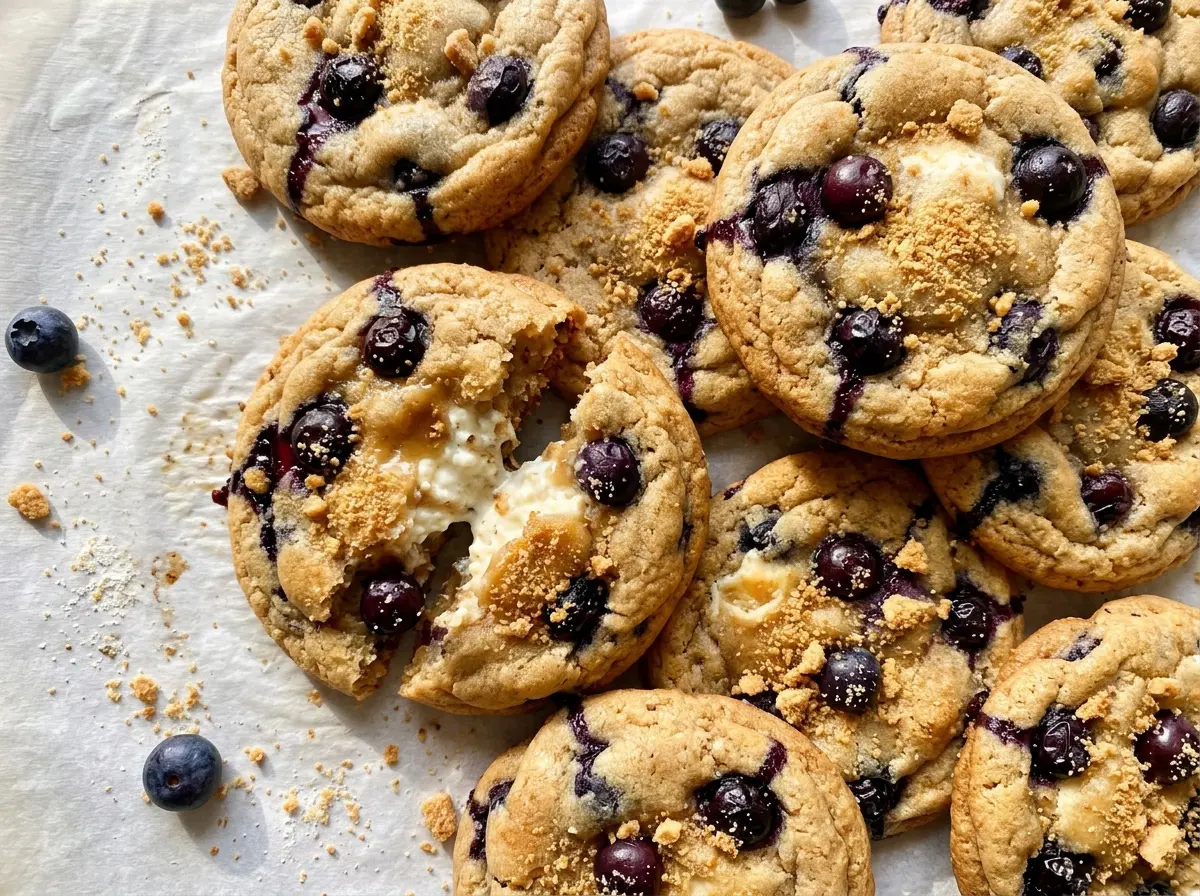
The first cookie you open should show a soft, pale cheesecake center tucked inside a blueberry-speckled edge. Getting that neat middle takes a little planning: the filling needs to be firm before it meets the dough, and every seam needs to be closed. These Blueberry Cheesecake Cookies bake in batches of nine, so there’s room to space them out and keep the second round chilled while the first bakes.
I use freeze-dried blueberries here because they bring concentrated berry flavor without adding the moisture fresh berries would bring to cookie dough. The cream cheese filling gets a small amount of cornstarch, which helps it stay smooth inside the cookie. Together, those choices give you a tender cookie with a creamy center, not a wet pocket of dough.
There’s a little waiting while the filling firms and the dough chills, but the hands-on work is straightforward. Once the cookies cool on the baking sheet, their lightly golden edges hold around that tangy cheesecake middle.
Kitchen Note
Keep the filling portions close in size. If one is much larger than the others, the dough is harder to seal evenly and that cookie may bake differently from the rest.
Save these Blueberry Cheesecake Cookies for a bake with crisp golden edges, freeze-dried berry pieces, and a creamy cheesecake center.
Why the Extra Yolk Matters Around a Cheesecake Center
These cookies have to do more than bake into a soft, chewy round: the dough also needs to wrap around a portion of filling and hold its shape as it bakes. The whole egg helps bind the dough, while the extra yolk adds richness and makes the dough more supple to shape. That balance is useful when you’re flattening each portion, placing the cold filling in the middle, and bringing the edges together.
There’s no need to add another egg white to use up the extra yolk. More white would bring additional moisture and could change the dough’s texture, making it less like the dough this filled cookie needs. Beat in the whole egg, the yolk, and the vanilla until combined, then stop once the flour disappears into the dough. Mixing longer than needed can make the cookies tougher.
The filling also affects how the cookie feels straight from the oven: the outside sets first, while the center stays creamy. Let the cookies rest on the baking sheet before moving them, so the warm dough has time to firm enough to lift without breaking.
Why Freeze-Dried Blueberries Fit Better Than Fresh Ones

- Freeze-dried blueberries — They add concentrated berry flavor without bringing extra liquid into the dough. Lightly crush them so the pieces distribute through the cookies; crushing them to dust would tint the dough more evenly and lose those little berry bites. Fresh blueberries aren’t a direct swap here because their moisture can make the dough wet around the fruit.
- Block cream cheese — The softened block blends smoothly with the powdered sugar and holds up as a portioned filling. Use block cream cheese rather than a soft, spreadable tub product, which has a looser texture and is harder to portion and freeze firmly.
- Cornstarch and powdered sugar — Both help the filling stay cohesive: powdered sugar sweetens it, and cornstarch helps give the mixture body. Whisk or stir until no streaks of cream cheese remain before portioning, so each center has a consistent texture.
- Unsalted butter and the two sugars — Softened butter creams with the sugars to form the base of the cookie dough. Light brown sugar brings moisture and a gentle molasses note; granulated sugar balances it. If you use dark brown sugar instead, keep the same amount and expect a deeper molasses flavor.
- Flour, baking soda, and salt — Whisk these dry ingredients together before adding them to the butter mixture so the leavener and salt don’t end up concentrated in one spot. Measure the flour without packing it down; too much flour makes it harder to seal the dough around the filling.
- Lemon juice and vanilla — Lemon juice gives the cream cheese mixture a little brightness, while vanilla rounds out the cookie dough. Keep each in its assigned mixture: the lemon goes in the filling, and the vanilla goes in with the egg and yolk.
How to Wrap the Filling Without Losing It in the Oven
Freeze the Cream Cheese Portions Firm
Stir the cream cheese, powdered sugar, cornstarch, and lemon juice in a small bowl until the mixture is smooth. Scoop 18 rounded 1-tablespoon portions onto a parchment-lined plate or small tray, leaving a little room between them. Freeze them for at least 1 hour, until firm enough to pick up and enclose in dough. If a portion feels soft when you start shaping, return it to the freezer rather than trying to wrap it.
Mix the Dough, Then Give It a Short Chill
Whisk the flour, baking soda, and salt in a medium bowl. In a large bowl, beat the softened butter with both sugars until creamy, about 2 minutes, then beat in the egg, egg yolk, and vanilla. Mix in the flour mixture just until combined, fold in the lightly crushed blueberries, cover the bowl, and refrigerate the dough for 30 minutes. Stop mixing as soon as the dry streaks disappear; a heavily worked dough can bake up less tender.
Seal Each Cookie and Bake in Two Batches
Heat the oven to 350°F and line an 18×13-inch rimmed baking sheet with parchment paper. Divide the dough into 18 equal portions, flatten each one, enclose a frozen filling portion, and seal the dough completely; set each cookie seam-side down. Keep the unshaped portions refrigerated and bake 9 cookies at a time, spaced about 2 inches apart. Bake each batch for 12 to 15 minutes, until the edges are lightly golden and the tops look set; rest the cookies on the sheet for 10 minutes before moving them to a wire rack, and let the sheet cool completely before baking the second batch.
Two Simple Ways to Change the Batch
Use Dark Brown Sugar for a Deeper Cookie
Swap the light brown sugar for the same amount of dark brown sugar. The cookies will have a stronger molasses note and a slightly deeper color, while the cheesecake center and blueberry pieces stay the same.
Leave Out the Blueberries for a Plain Cheesecake Cookie
For a simpler flavor, omit the freeze-dried blueberries and make the cookies with the same cheesecake centers. The dough will be plain rather than berry-speckled, so keep the portions and filling enclosed just as carefully.
Storage and Reheating
- Refrigerator: Store the cooled cookies in an airtight container in the refrigerator for up to 4 days. The cookie may firm up when cold, while the filling stays creamy.
- Freezer: Freeze cooled cookies in a sealed, freezer-safe container for up to 2 months. Thaw them in the refrigerator before serving.
- Reheating: These are best chilled or after a short rest at room temperature; reheating isn’t necessary. Avoid microwaving, which can heat the cream cheese center unevenly and soften the cookie around it.
Questions That Come Up While Making These Cookies
Blueberry Cheesecake Cookies
Ingredients
Equipment
Method
- In a small bowl, mix the cream cheese, powdered sugar, cornstarch, and lemon juice until smooth.
- Scoop the mixture into 18 rounded 1-tablespoon portions on a parchment-lined plate or small tray, then freeze until firm, at least 1 hour.
- In a medium bowl, whisk together the flour, baking soda, and salt.
- In a large bowl, beat the butter, brown sugar, and granulated sugar until creamy, about 2 minutes.
- Beat in the egg, egg yolk, and vanilla extract.
- Mix in the flour mixture just until combined, then fold in the blueberries.
- Cover and refrigerate the dough for 30 minutes.
- Heat the oven to 350°F and line an 18x13-inch rimmed baking sheet with parchment paper.
- Divide the dough into 18 equal portions.
- Flatten each portion, enclose a frozen cheesecake filling portion inside, and seal the dough completely.
- Place each cookie seam-side down; keep unshaped portions refrigerated and space 9 cookies about 2 inches apart on the baking sheet.
- Bake each batch for 12 to 15 minutes, until the edges are lightly golden and the tops look set.
- Let the cookies rest on the baking sheet for 10 minutes before transferring to a wire rack.
- Let the baking sheet cool completely before baking the second batch.