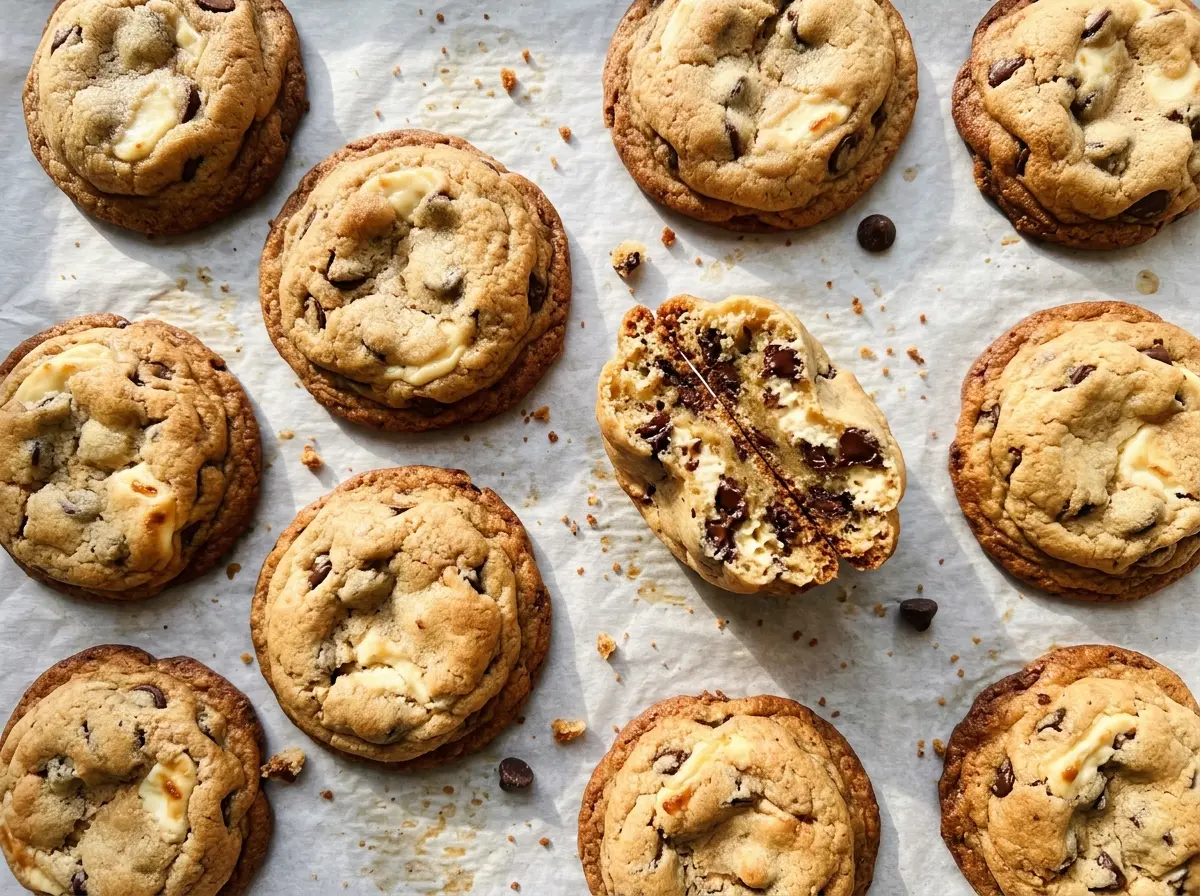
The edges turn lightly golden before the centers look fully set, and that’s exactly when these Chocolate Chip Cheesecake Cookies should come out of the oven. They finish settling on the baking sheet, leaving you with soft middles and plenty of semisweet chocolate in every bite. I like that the cream cheese is part of the dough itself, so the cookies have a tender texture without a separate filling to fuss with.
There’s no special equipment or complicated shaping here: the dough gets scooped into simple portions, and the oven does the rest. A short rest on the hot pan is part of the bake, not an optional pause; moving them too soon can leave the centers fragile. Once cooled, they’re soft, chocolatey cookies with a faint cheesecake-like richness and lightly golden edges.
Kitchen Note
Don’t rush the one-hour chill. The dough should feel firm enough to portion cleanly, rather than soft and sticky from the mixer.
Save these Chocolate Chip Cheesecake Cookies for a bake with soft centers, golden edges, and chocolate in every bite.
Why Cream Cheese Makes These Cookies Tender Without Turning Them Into Cheesecake
Cream cheese is beaten right into the butter and sugars, so its effect runs through the whole cookie instead of sitting in a dense pocket at the center. It brings richness and tenderness to the dough, while the flour and egg give the cookies enough structure to hold their shape. The result is a soft cookie, not a cheesecake bar tucked inside a chocolate chip cookie.
The balance matters here. Brown sugar helps keep the crumb soft, while granulated sugar adds sweetness without taking over the texture. The cream cheese also changes how the dough feels compared with a standard chocolate chip cookie dough: it should be creamy after mixing, then firmer after its rest in the refrigerator. If you expect a crisp, thin cookie, this dough is aiming somewhere else. Its lightly golden edges and soft middle are the point.
What Each Ingredient Is Doing in This Cheesecake Cookie Dough

- All-purpose flour — It gives the cookies their structure and keeps the cream cheese-rich dough from spreading into puddles. Spoon flour into the measuring cup and level it rather than packing the cup; too much flour can make the centers dry. For a gluten-free version, use a cup-for-cup baking blend that includes xanthan gum, as described below.
- Unsalted butter and cream cheese — Both should be softened so they beat smoothly with the sugars; melted butter can leave the dough loose and greasy. Standard unsalted butter is a good choice here, and block-style cream cheese gives the dough a predictable texture. Neufchâtel can replace the cream cheese in the same quantity, though the cookies will be a little less rich.
- Brown and granulated sugar — The packed brown sugar lends moisture and a deeper caramel note, while granulated sugar keeps the sweetness balanced. Keep both in the dough; changing the ratio can shift the spread and softness.
- Egg and vanilla — A room-temperature egg blends more evenly into the creamed mixture than a cold one. Vanilla rounds out the chocolate and cream cheese; regular vanilla extract works well, so there’s no need to reach for an expensive bottle.
- Semisweet chocolate chips — They give the cookies chocolate in each scoop without making the dough overly sweet. Chopped semisweet chocolate is a useful swap in the same volume; it melts into larger pockets, while chips hold their shape more distinctly.
- Baking soda and kosher salt — Baking soda helps the cookies bake up rather than stay dense, and salt keeps the sweetness from tasting flat. Stick with baking soda here; baking powder isn’t a direct one-for-one replacement.
From Creamy Dough to Soft-Centered Cookies
Whisk the Dry Ingredients Evenly
Whisk the flour, baking soda, and kosher salt together in a medium bowl before they meet the wet ingredients. This distributes the leavener through the flour, so one cookie doesn’t get a concentrated bite of baking soda. Break up any visible flour clumps as you whisk. Set the bowl aside while you cream the butter and cream cheese.
Beat the Butter, Cream Cheese, and Sugars
Beat the softened butter, cream cheese, brown sugar, and granulated sugar in a large bowl until the mixture looks smooth and creamy, about 2 minutes. Scrape the bowl if you see streaks of cream cheese or butter clinging to the sides. Add the room-temperature egg and vanilla, then beat just until combined. A smooth mixture at this point helps the dough come together without needing extra mixing later.
Mix in the Flour, Then Fold in the Chocolate
Add the flour mixture on low speed and stop as soon as no dry streaks remain. Mixing longer than that can tighten the dough and make the cookies less tender. Fold in the semisweet chocolate chips so they’re spread throughout without beating them into the dough. Cover the bowl before chilling so the dough doesn’t dry out in the refrigerator.
Chill, Portion, and Bake on Two Sheets
Refrigerate the covered dough for 1 hour. Heat the oven to 350°F with racks in the upper and lower thirds, and line two 18×13-inch baking sheets with parchment paper. Scoop the dough into 2-tablespoon portions, leaving at least 2 inches between them. Bake for 11–13 minutes, swapping the sheets between racks and rotating them front to back halfway through; look for set, lightly golden edges with centers that still look soft.
Let the Cookies Set Before Moving Them
Leave the cookies on the baking sheets for 5 minutes after they come out of the oven. Their centers are delicate while hot, and the brief rest lets them firm enough to lift without breaking. Transfer them to a wire rack to cool completely. If you move them straight from the oven, the soft middle may tear or slump before it has a chance to set.
Two Easy Ways to Change the Chocolate Chip Cheesecake Cookies
Make Them Gluten-Free
Replace the all-purpose flour with the same volume of a cup-for-cup gluten-free baking blend that contains xanthan gum. The cookies may have a slightly more delicate crumb, so let them complete their full 5-minute rest on the baking sheets before transferring them.
Use Milk Chocolate for a Sweeter Cookie
Swap the semisweet chips for milk chocolate chips in the same quantity. The finished cookies will taste sweeter and creamier, so this is a good change if you prefer a softer chocolate flavor against the tang of the cream cheese.
Storage and Reheating
- Refrigerator: Store completely cooled cookies in an airtight container for up to 5 days. Chilling firms the centers; let them sit at room temperature before serving for a softer bite.
- Freezer: Freeze cooled cookies in an airtight container, with parchment between layers, for up to 2 months. Thaw at room temperature.
- Reheating: Warm cookies in a 300°F oven for a few minutes, just until soft. Don’t leave them in until the chocolate is fully melted or the edges may dry out.
Questions That Come Up While Baking These Cookies
Chocolate Chip Cheesecake Cookies
Ingredients
Equipment
Method
- Whisk the flour, baking soda, and salt together in a medium bowl.
- Beat the butter, cream cheese, brown sugar, and granulated sugar in a large bowl until smooth and creamy, about 2 minutes.
- Beat in the egg and vanilla until combined.
- Mix in the flour mixture on low speed just until no dry streaks remain.
- Fold in the chocolate chips.
- Cover the bowl and refrigerate the dough for 1 hour.
- Heat the oven to 350°F with racks in the upper and lower thirds.
- Line two 18x13-inch baking sheets with parchment paper.
- Scoop the dough into 2-tablespoon portions and arrange them at least 2 inches apart on the prepared baking sheets.
- Bake for 11–13 minutes, swapping the sheets between racks and rotating them front to back halfway through, until the edges are set and lightly golden while the centers remain soft.
- Cool the cookies on the baking sheets for 5 minutes.
- Transfer them to a wire rack to cool completely.