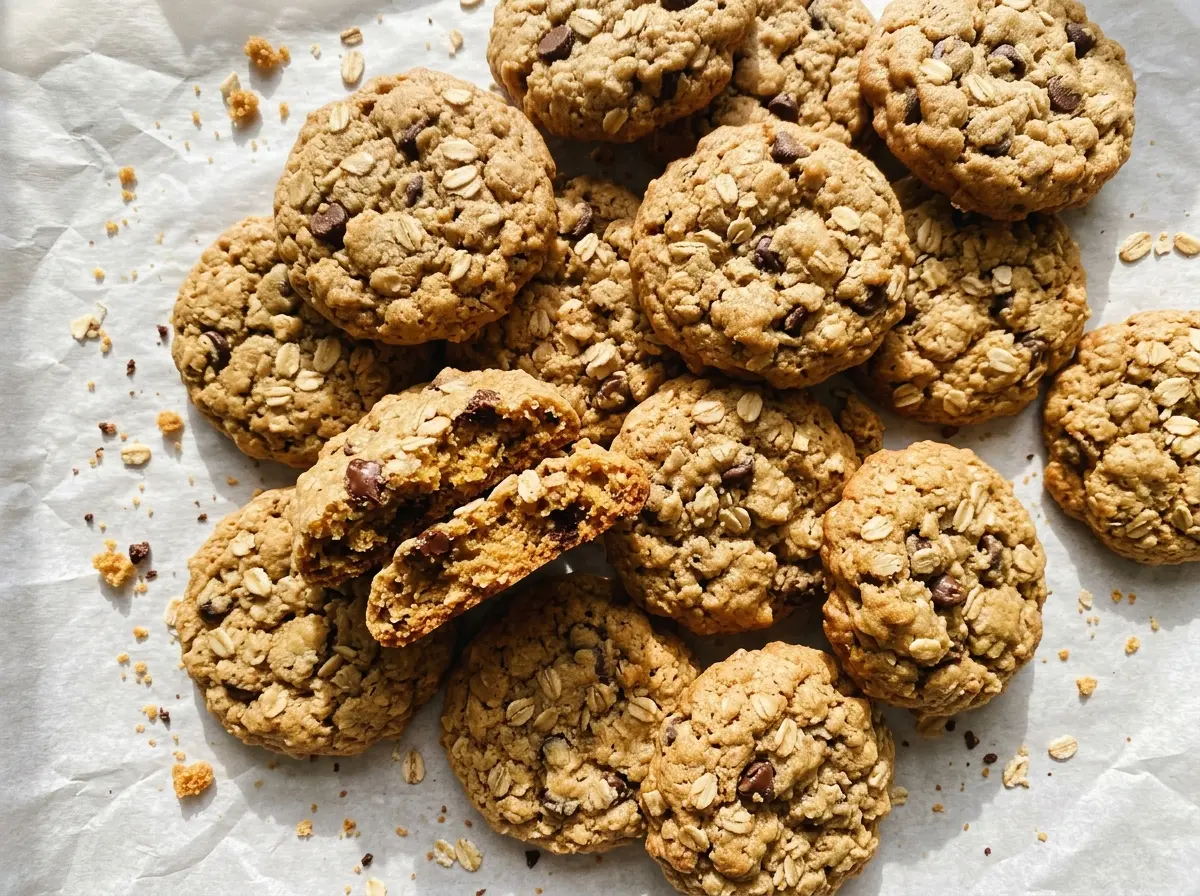
The butter and sugars turn pale and creamy before anything else goes into the bowl, and that gives these cookies their soft, chewy middle. The dough is thick with oats, so every scoop gets a little crunch at the edge and plenty of chocolate. I like that these gluten free oatmeal chocolate chip cookies don’t need a special flour mix made from scratch—just a measure-for-measure blend that already contains xanthan gum.
The dough rests in the refrigerator before it goes onto the baking sheets. That short chill helps it hold its shape in the oven, while old-fashioned oats keep the texture hearty instead of sandy or too fine. Pull the cookies when the edges are golden and the centers still look soft, and you’ll have tender oatmeal cookies with chocolate in every bite.
Kitchen Note
Room-temperature eggs blend into creamed butter more smoothly than cold ones. Add them one at a time, giving the mixture a brief beat between additions so it stays cohesive.
Save these gluten free oatmeal chocolate chip cookies for a soft-centered batch packed with oats and semisweet chocolate.
Why the Brown Sugar and White Sugar Both Matter
Using two kinds of sugar gives these cookies more than sweetness. Packed light brown sugar brings moisture, which helps the centers stay chewy around all those oats. Granulated sugar has less moisture and helps the edges bake up golden instead of leaving the whole cookie soft and cakey.
Keep the balance between them rather than replacing one sugar with the other. If you use only granulated sugar, the cookies lose some of that tender, chewy center. If you use only brown sugar, they’ll be softer throughout and won’t get the same golden edge. Packing the brown sugar into the measuring cup also matters; a loose cup changes the balance in the dough. These cookies are at their best when the centers stay soft and the edges have just enough color to hold their shape.
The Gluten-Free Flour and Oats Have Different Jobs

- Gluten-free flour blend — Choose a measure-for-measure all-purpose blend that includes xanthan gum. That binder helps the cookies hold together without wheat flour; a single-ingredient flour such as almond or coconut flour won’t behave the same way. A different measure-for-measure blend with xanthan gum is the closest practical swap.
- Old-fashioned rolled oats — Their broad flakes give the cookies a distinct, pleasantly chewy texture. Use oats labeled certified gluten-free when the cookies need to stay gluten-free, since oats can come into contact with gluten-containing grains during processing.
- Unsalted butter — A standard grocery-store butter works well here; it doesn’t need to be a specialty brand. Unsalted butter lets the fine salt in the dough provide the seasoning without adding an unknown amount from the butter itself.
- Large eggs — They add moisture and help bind the oats and flour blend into a scoopable dough. Use large eggs for the intended balance; smaller eggs can leave the dough drier and harder to bring together.
- Semisweet chocolate chips — Choose chips labeled gluten-free if that matters for your kitchen. Semisweet keeps the cookies from becoming overly sweet, and ordinary baking chips are fine; there’s no need to buy a premium brand.
Chill the Dough Before It Goes on the Baking Sheets
Cream the Butter and Sugars Until Smooth
Heat the oven to 350°F and line two 18×13-inch baking sheets with parchment paper. Beat the softened butter with the packed light brown sugar and granulated sugar in a large bowl for about 2 minutes, until creamy. If the butter is too firm, it won’t blend evenly; if it’s melted, the dough won’t have the same starting texture. Stop when the mixture looks smooth and unified, not greasy.
Add the Eggs One at a Time
Beat in the eggs individually, then mix in the vanilla extract. Scrape the sides of the bowl if butter or sugar is clinging there so the next ingredients can mix in evenly. The mixture may look a little loose at this stage, but it should be cohesive rather than separated. Don’t add the flour until the vanilla is mixed through.
Mix in the Dry Ingredients, Oats, and Chocolate
Whisk the gluten-free flour blend, baking soda, and fine salt in a medium bowl before adding them to the butter mixture. Mix on low just until the flour disappears; prolonged mixing isn’t needed. Stir in the rolled oats and semisweet chocolate chips, cover the bowl, and refrigerate the dough for 30 minutes. The chilled dough should feel firmer and hold a rounded scoop instead of slumping in the spoon.
Bake Until the Edges Turn Golden
Scoop rounded 2-tablespoon portions onto the lined sheets, leaving about 2 inches between cookies. Bake for 10 to 12 minutes, rotating the sheets halfway through so they color evenly. Look for golden edges and centers that still appear slightly soft; they’ll continue to set as they cool. Leave the cookies on the baking sheets for 5 minutes, then transfer them to a wire rack to cool completely.
Three Simple Ways to Change the Chocolate or Make Them Dairy-Free
Use dark chocolate chips
Swap the semisweet chips for the same volume of dark chocolate chips labeled gluten-free. The cookies will taste less sweet and more cocoa-forward, while keeping the same oat-and-chocolate texture.
Make a dairy-free batch
Use softened dairy-free butter sticks in place of the butter, along with dairy-free chocolate chips labeled gluten-free. Tub-style spreads contain more water and can make cookies spread unpredictably, so choose a stick product; the finished cookies may still spread a little differently by brand.
Trade the chocolate for raisins
Replace the chocolate chips with raisins for a fruitier oatmeal cookie. Raisins bring a concentrated sweetness and a softer chew, so the cookies won’t have the same chocolate richness; the dough and baking method stay the same.
Storage and Reheating
- Refrigerator: These cookies don’t need refrigeration. Keep them in an airtight container at room temperature for up to 4 days; chilling them can make the texture firmer.
- Freezer: Freeze fully cooled cookies in an airtight freezer container for up to 2 months. Thaw at room temperature before serving.
- Reheating: They’re best at room temperature, so reheating isn’t necessary. Let frozen cookies thaw on the counter rather than microwaving them, which can make the chocolate overly soft.
Questions That Come Up When Baking These Gluten-Free Cookies
Gluten Free Oatmeal Chocolate Chip Cookies
Ingredients
Equipment
Method
- Heat the oven to 350°F.
- Line two 18x13-inch baking sheets with parchment paper.
- In a large bowl, beat the butter, brown sugar, and granulated sugar with an electric mixer until creamy, about 2 minutes.
- Beat in the eggs one at a time.
- Mix in the vanilla extract.
- In a medium bowl, whisk together the gluten-free flour blend, baking soda, and salt.
- Add the flour mixture to the butter mixture and mix on low just until combined.
- Stir in the oats and chocolate chips.
- Cover the bowl and refrigerate the dough for 30 minutes.
- Scoop rounded 2-tablespoon portions onto the prepared baking sheets, spacing them about 2 inches apart.
- Bake for 10 to 12 minutes, rotating the sheets halfway through, until the edges are golden and the centers still look slightly soft.
- Cool the cookies on the baking sheets for 5 minutes.
- Transfer the cookies to a wire rack to cool completely.