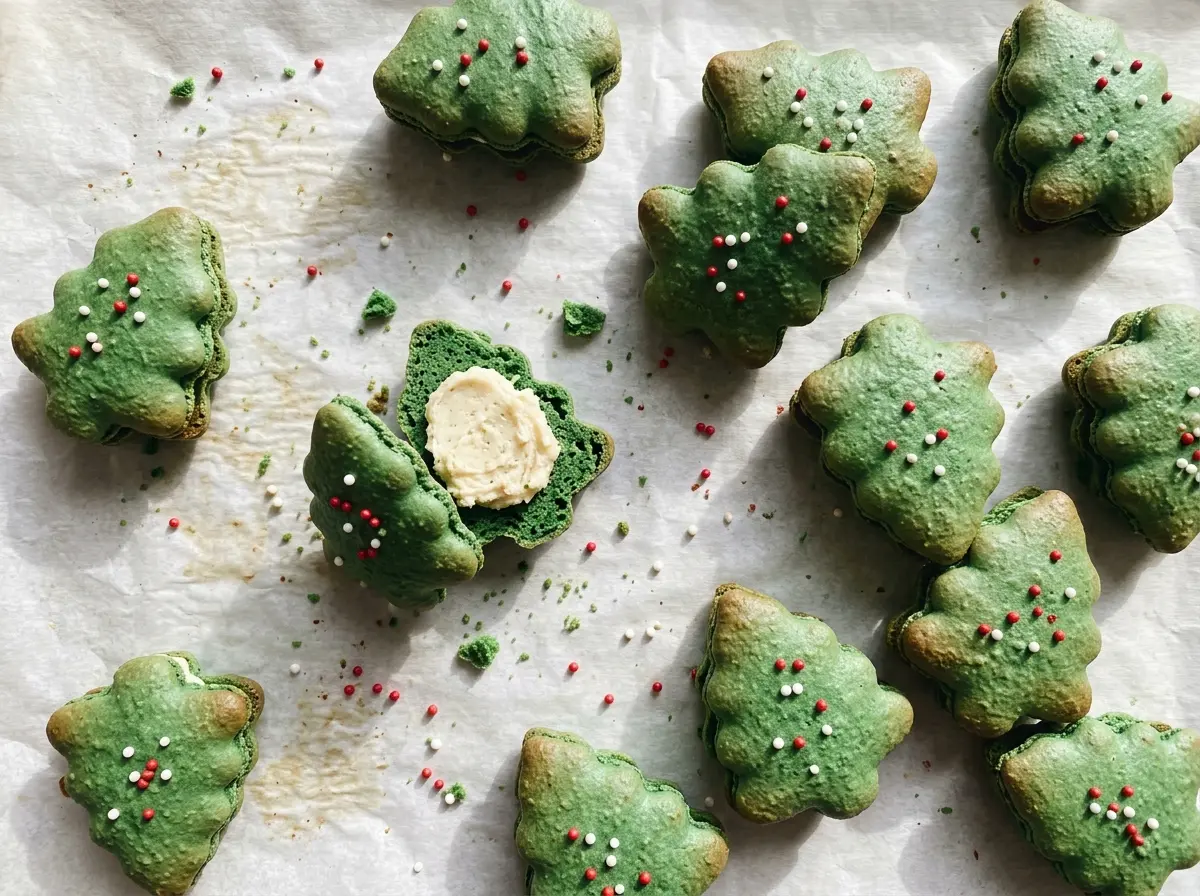
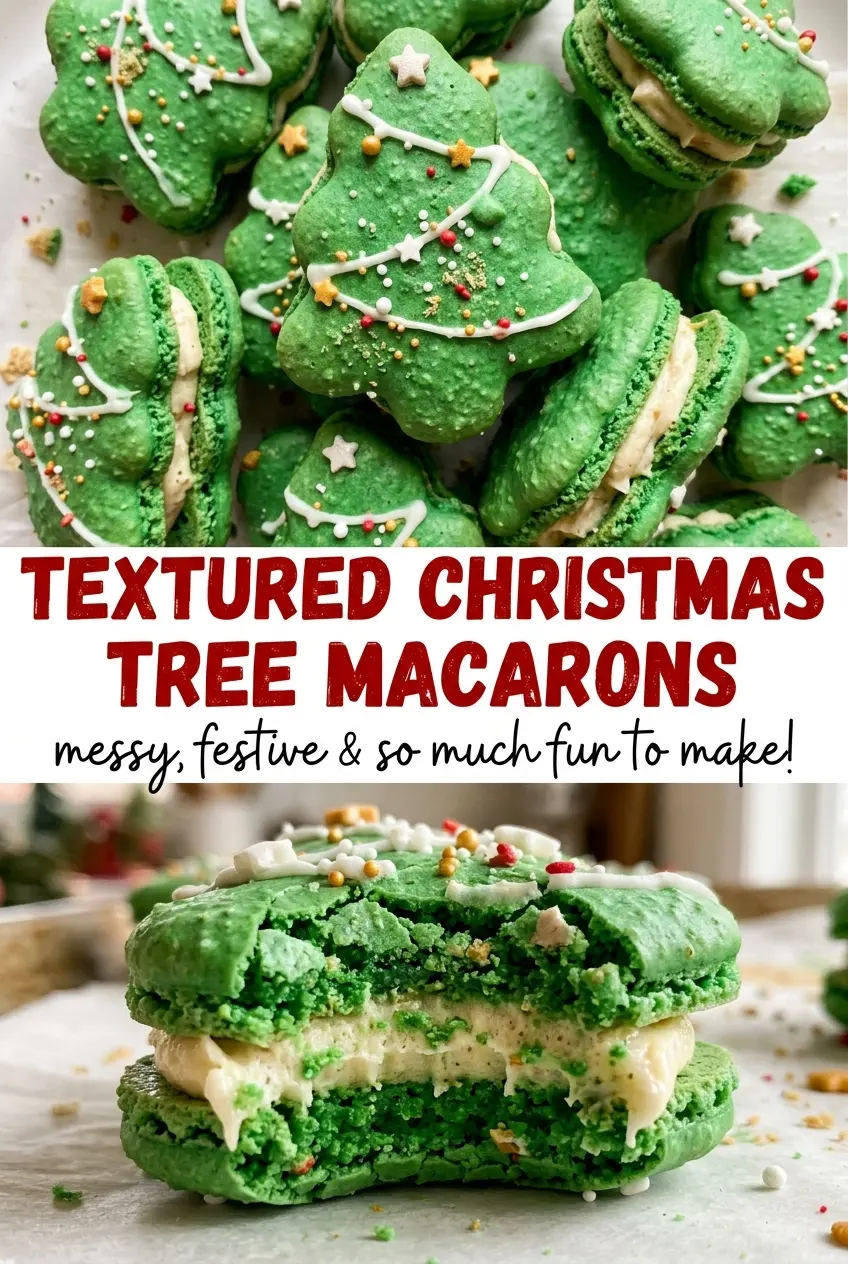
The first tray of macarons can be a little nerve-racking: the batter looks glossy, the piped branches seem fragile, and you’re waiting to see whether those ridges hold their shape in the oven. With these textured Christmas tree macarons, the star-shaped piping tip gives each little tree its branch detail before baking, so there’s no extra decorating step to create the texture.
I like this design because the trees are recognizable without needing a complicated finish. A steady zigzag from a narrow top to a wider base gives the shells their shape, and a small dab of buttercream holds a yellow star at the tip. The green gel coloring keeps the batter vivid without adding much liquid.
Once the shells are filled, a rest in the refrigerator lets the buttercream settle into them. Bring them back to room temperature before serving, and the ridged shells meet a smooth, tender center in every bite.
Kitchen Note
Give the piped shells the full drying rest rather than rushing them into the oven. They’re ready when the surface feels dry and doesn’t cling to a light touch; that cue matters more than picking a time at the short end of the range.
Save these textured Christmas tree macarons for a holiday baking day—the ridged green branches and little yellow stars make each one a tiny finished tree.
Why the Branches Need an Open-Star Tip, Not a Smooth Pipe
The ridges aren’t just decoration added after the macarons bake. They’re built into each shell when you pipe the batter through a 1/4-inch open-star tip. As the zigzags connect, the grooves make the surface read like layered branches, even though the batter itself is smooth and glossy.
A round tip would give you a tree outline, but the branches would look flatter and more like a solid triangle. The open-star tip also gives you a useful visual guide: keep the zigzags close enough to connect, but don’t pile one row heavily on top of the next. Start narrow at the top and widen toward the base to follow the tree outline underneath the parchment.
If the piping bag feels awkward at first, focus on moving across the tree in horizontal passes rather than trying to draw a perfect tree in one stroke. Connected lines create the ridged look and help each shell bake as one piece. The finished trees don’t need to be identical; pairing shells of similar size matters more when you assemble them.
What the Almond Flour, Egg Whites, and Gel Color Each Bring
- Almond flour — Finely ground almond flour gives macaron shells their characteristic structure and delicate bite. Sifting it with the shell portion of the powdered sugar catches larger pieces; press almond clumps through the sieve instead of leaving them behind. Coarse almond meal won’t make the same smooth batter, so it isn’t a direct swap.
- Egg whites — Room-temperature whites whip more readily into the foamy base for the meringue. Use a clean, grease-free bowl; even a greasy film can interfere with getting the glossy, stiff peaks that hold the piped shape.
- Granulated sugar — This goes into the egg whites gradually as they’re beaten. Adding it in stages lets it incorporate into the meringue instead of landing in one heavy pile.
- Powdered sugar — It has two jobs here: part combines with the almond flour for the shells, while the rest sweetens and thickens the buttercream. Keep those portions separate while you measure; using the filling portion in the shell mixture would leave the buttercream short.
- Green gel food coloring — Gel gives the shells their tree color without adding the extra liquid that can loosen macaron batter. Gel quality matters more than brand; the color should be concentrated so a small amount colors the meringue.
- Butter, cream, and vanilla — Softened unsalted butter makes the filling smooth and pipeable, while heavy cream loosens it and vanilla rounds out its sweetness. Use butter that’s soft enough to beat smoothly but not melted. The fine salt balances the filling rather than making it taste salty.
- Yellow star sprinkles — One small star finishes each tree at the tip. A small size suits the shell; an oversized sprinkle can overwhelm the narrow top.
From Stiff Meringue to Filled, Maturing Tree Macarons
Set Up the Pans and Build the Meringue
Heat the oven to 300°F and line two 13×18-inch rimmed baking sheets with parchment. Mark 18 evenly spaced tree outlines, each 1 1/2 inches wide and 2 inches tall, on the underside of each sheet so the guides don’t touch the batter. Sift the almond flour with the shell portion of powdered sugar into a medium bowl, pressing any almond clumps through. In a clean, grease-free bowl, beat the room-temperature egg whites until foamy, gradually add the granulated sugar, then add the green gel coloring at soft peaks and continue beating to stiff, glossy peaks.
Fold to a Thick Ribbon and Pipe the Branches
Fold the almond mixture into the meringue in three additions, turning the bowl as you fold so the dry ingredients blend in evenly. Stop when the batter flows in a thick ribbon and you can draw a figure 8 without the stream breaking; batter that’s too stiff won’t pipe smoothly, while overworked batter can spread. Transfer it to a piping bag fitted with a 1/4-inch open-star tip. Pipe connected horizontal zigzags inside each guide, beginning narrow at the top and widening toward the base.
Tap, Rest, and Bake One Sheet at a Time
Tap each pan firmly on the counter 2 or 3 times to release larger air pockets, then let the shells rest for 30 to 60 minutes. The surface should feel dry and shouldn’t stick when touched lightly. Bake one sheet at a time on the middle rack for 15 to 18 minutes, until the shells are set and the feet look dry. If they still look wet at the base, give them more time within that range rather than pulling them before they’re set.
Cool, Fill, and Add the Stars
Leave the baked shells on their pans until completely cool, about 20 to 30 minutes, then carefully peel them from the parchment. Beat the softened butter until smooth, then gradually beat in the remaining powdered sugar, heavy cream, vanilla, and fine salt until the filling is smooth and pipeable. Pair similarly sized shells and pipe or spread about 2 teaspoons of filling onto the flat side of 18 shells; sandwich each with a matching shell. Dab a little of the remaining filling onto each tree tip and press on a yellow star sprinkle.
Give the Filled Macarons Time to Mature
Arrange the assembled macarons in an airtight container and refrigerate them for at least 12 hours and up to 24 hours. This resting time lets the filling settle into the shells rather than staying as a separate layer. Before serving, bring them to room temperature for 20 minutes. The stars stay in place, and the buttercream is softer and easier to bite through once it’s no longer cold.
Three Ways to Change the Look Without Changing the Batter
Pale almond trees
Leave out the green gel coloring for pale, uncolored shells, then keep the same tree piping and buttercream. The shape still reads as a tree, but it loses the bright green contrast that makes the branch ridges stand out.
Dairy-free ridged shells
The shells themselves contain no dairy, so for a dairy-free version, leave off the buttercream filling and the star decorations and serve the green shells on their own. They’ll keep the piped tree shape, but you won’t have the soft filling between them.
Round green macarons
Pipe the batter as small rounds instead of tree-shaped zigzags, then sandwich matching shells with the same buttercream. You’ll get the familiar macaron shape and keep the green color, but give up the ridged branches and tree silhouette.
Storage and Reheating
- Refrigerator: Keep the macarons airtight for up to 3 days. The shells soften slightly as they sit with the filling, which is part of their matured texture.
- Freezer: They freeze well in an airtight container. Thaw them in the refrigerator while still sealed, then bring them to room temperature before opening the container to limit condensation on the shells.
- Reheating: Don’t heat these; bring them to room temperature for 20 minutes before serving. Warming them can soften the buttercream too much and blur the crisp ridges.
Questions That Come Up While Making Tree Macarons
Textured Christmas Tree Macarons
Ingredients
Equipment
Method
- Preheat the oven to 300°F.
- Line two 13x18-inch rimmed baking sheets with parchment; mark 18 evenly spaced tree outlines, each 1 1/2 inches wide and 2 inches tall, on the underside of each sheet.
- Sift the almond flour and 4 1/4 ounces powdered sugar into a medium bowl, pressing any almond clumps through the sieve.
- In a clean, grease-free bowl, beat the egg whites until foamy.
- Gradually add the granulated sugar while beating the egg whites.
- When soft peaks form, add the green gel food coloring and beat to stiff, glossy peaks.
- Fold the almond flour mixture into the meringue in three additions until the batter flows in a thick ribbon and can be drawn into a figure 8 without breaking.
- Transfer the batter to a piping bag fitted with a 1/4-inch open-star tip.
- Pipe connected horizontal zigzags inside each tree outline, starting narrow at the top and widening toward the base to create ridged branches.
- Tap each baking sheet firmly on the counter 2 or 3 times.
- Let the shells rest for 30 to 60 minutes, until their surfaces feel dry and do not stick when lightly touched.
- Bake one sheet at a time on the middle rack for 15 to 18 minutes, until the shells are set and the feet look dry.
- Cool the shells completely on the baking sheets, about 20 to 30 minutes.
- Carefully peel the cooled shells off the parchment.
- Beat the butter until smooth.
- Gradually beat in the remaining 6 ounces powdered sugar, heavy cream, vanilla, and salt until smooth and pipeable.
- Pair similarly sized shells.
- Pipe or spread about 2 teaspoons filling onto the flat side of 18 shells.
- Sandwich each filled shell with a matching shell.
- Dab a little remaining filling onto the tip of each tree.
- Press one star sprinkle onto each tree tip.
- Refrigerate the macarons in an airtight container for at least 12 hours and up to 24 hours.
- Bring the macarons to room temperature for 20 minutes before serving.